
The owner can see when a delivery promise is becoming dangerous. A senior operator can hear when a machine is beginning to run differently. A long-serving supervisor knows which job will create trouble before it reaches the floor.
The factory works because a small number of people carry years of judgment in their heads. Much of this is tacit knowledge: expertise developed through experience that can be difficult to fully express or document.1
That knowledge is valuable. It is also fragile.
When an improvement depends on the same people noticing the same signals, making the same decisions and pushing the same follow-up, it has not yet become part of the organization. It remains a personal capability temporarily producing an organizational result.
That is why some manufacturing improvements look successful for several months and then quietly fade.
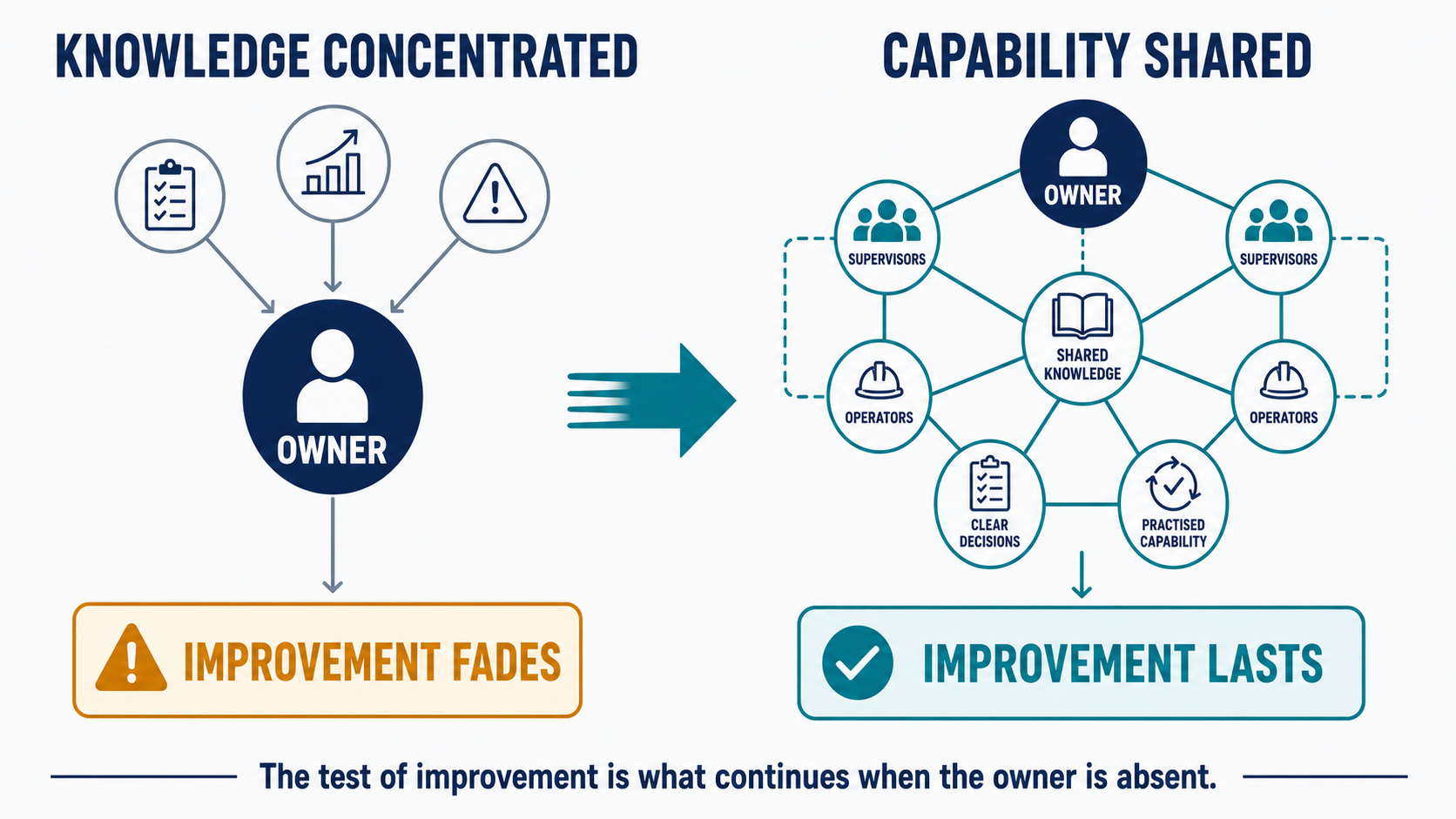
The Improvement Was Real. The Capability Was Not Yet Shared.
An owner may introduce a morning meeting, clearer scheduling rules, new performance measures or a problem-solving routine. At first, results improve.
Orders move more predictably. Problems become visible. People respond faster.
Then the owner becomes occupied with a customer issue, an equipment purchase or a staffing problem. A key supervisor leaves. Production pressure rises. The new routine becomes shorter, less consistent and eventually optional.
It is tempting to conclude that employees resisted the change.
Often, the more accurate explanation is that the organization never learned how to sustain it without the person who introduced it. Research on organizational learning distinguishes between an individual's expertise and knowledge that has become embedded in shared routines, systems and organizational memory.2
The procedure may have been documented, but the judgment behind it was not transferred:
- Which problems require immediate escalation?
- Which customer promise should take priority?
- When is it acceptable to stop production?
- What trade-off is the business willing to make?
- Who has the authority to decide?
A checklist cannot answer every one of those questions. But leaving every answer inside the owner's head creates a factory that can only perform at its best when the owner is present.
The Hidden Cost of Knowledge Concentration
Knowledge concentration rarely appears as one dramatic failure. It appears in everyday operating friction:
- decisions wait for one person;
- supervisors escalate issues they should be able to resolve;
- experienced employees become permanent bottlenecks;
- newer employees copy habits rather than understand principles;
- the same problems return after improvement projects end;
- vacations, retirements and turnover create disproportionate disruption.3
The financial consequence is larger than delayed decisions.
The company becomes harder to scale, harder to transfer and harder for a buyer or successor to understand. Its performance may be strong, but that performance is tied to particular people rather than a visible operating capability.
This matters as manufacturers face a persistent shortage of skilled people. Deloitte and The Manufacturing Institute estimated that the United States may need 3.8 million additional manufacturing workers between 2024 and 2033, with as many as 1.9 million positions potentially unfilled if workforce challenges are not addressed.4
The lesson for an owner-led Canadian factory is not simply to recruit harder. It is to make better use of the knowledge already inside the business and create a reliable way for that knowledge to move.
Documentation Is Necessary, but It Is Not Enough
When knowledge is concentrated, the usual response is to document everything.
That is useful, but a binder of procedures is not the same as an operating system.
Some manufacturing knowledge is explicit: settings, sequences, inspection requirements and maintenance intervals. It can be written down.
Other knowledge is tacit. It has been developed through experience: recognizing an abnormal sound, questioning an unrealistic schedule or knowing when a small quality issue signals a larger process problem. Tacit knowledge is normally shared through observation, practice, interaction and common experience rather than through written instructions alone.5
Tacit knowledge is transferred through participation:
- Experienced people explain not only what they do, but what they notice.
- Employees practise decisions inside clear boundaries.
- Leaders review the reasoning, not only the result.
- Teams improve the standard together when reality exposes a gap.
- Authority expands as capability becomes visible.
This is collaborative process documentation. The process does not leave people's heads because somebody writes a perfect manual. It leaves their heads because the people who know the work help others understand, test and improve it. Research on knowledge creation describes this movement between tacit and explicit knowledge as a social, iterative process rather than a one-time documentation exercise.6
Why Telling People to "Take Ownership" Usually Fails
Owners often want employees to take more initiative. Employees often want more clarity and authority.
Both can be telling the truth.
Responsibility without decision rights feels risky. Authority without capability is risky. Accountability without trust produces caution, not ownership. Research on motivation similarly identifies autonomy and competence as basic conditions supporting sustained, self-directed action.7
Research on psychological safety and team learning has repeatedly shown that people are more likely to raise concerns, discuss errors and learn when speaking up is not treated as a personal threat.8 Later reviews have found psychological safety consistently connected to employee voice, learning behaviour and team effectiveness.9 That does not mean lowering standards. It means making problems discussable early enough to solve them.
Clarity before delegation. Capability before accountability. Evidence before trust.
An owner cannot announce that the team is empowered and expect years of dependency to disappear. People need repeated experience making decisions, receiving useful feedback and seeing that responsible initiative is supported. Research on self-efficacy supports the importance of successful practice and feedback in building confidence to act.10
A Better Test of Improvement
The strongest measure of improvement is not what happens while the owner is driving it.
It is what continues when the owner is absent.
Consider one recurring operating decision in your factory and ask:
- Is the decision rule clear?
- Does more than one person understand the reasoning behind it?
- Does that person have authority to act?
- Can the team identify when the rule no longer fits reality?
- Is there a routine for learning from the outcome?
If the answer depends on one person's presence, the business has expertise, but it has not yet built organizational capability.
The goal is not to make the owner unnecessary.
It is to stop using the owner's constant availability as a substitute for a capable organization.
That is how improvement survives pressure. It is also how a factory becomes more resilient, more transferable and less exhausting to own.
Footnotes
- Michael Polanyi, The Tacit Dimension (University of Chicago Press, 1966). ↩
- Mary M. Crossan, Henry W. Lane and Roderick E. White, "An Organizational Learning Framework: From Intuition to Institution," Academy of Management Review 24, no. 3 (1999): 522–537. DOI ↩
- Dorothy Leonard and Walter Swap, Deep Smarts: How to Cultivate and Transfer Enduring Business Wisdom (Harvard Business School Press, 2005). ↩
- Deloitte and The Manufacturing Institute, Taking Charge: Manufacturers Support Growth with Active Workforce Strategies (2024). Source ↩
- Ikujiro Nonaka, "A Dynamic Theory of Organizational Knowledge Creation," Organization Science 5, no. 1 (1994): 14–37. DOI ↩
- Ikujiro Nonaka and Hirotaka Takeuchi, The Knowledge-Creating Company (Oxford University Press, 1995). ↩
- Edward L. Deci and Richard M. Ryan, "The 'What' and 'Why' of Goal Pursuits," Psychological Inquiry 11, no. 4 (2000): 227–268. DOI ↩
- Amy C. Edmondson, "Psychological Safety and Learning Behavior in Work Teams," Administrative Science Quarterly 44, no. 2 (1999): 350–383. DOI ↩
- Amy C. Edmondson and Derrick Bransby, "Psychological Safety Comes of Age," Annual Review of Organizational Psychology and Organizational Behavior 10 (2023): 55–78. DOI ↩
- Albert Bandura, Self-Efficacy: The Exercise of Control (W. H. Freeman, 1997). ↩