
“You've given me a second life.”
A lovely, cheerful, 67-year-old operator said this to me in tears at our Brampton, Ontario facility. He told me he felt people saw him as unworthy because he was old and slow.
That conversation stayed with me.
What the job demanded
His job meant standing for eight hours a day, bending down to fasten back panels coming along a conveyor. While bending, he had to hold a quarter-inch heavy-duty rivet gun weighing almost 10 lb. The workstation was moving approximately 202 units a day.
Even a younger person would have struggled with those physical demands. Before judging someone's pace, we needed to look closely at the work we were asking them to repeat throughout the shift.
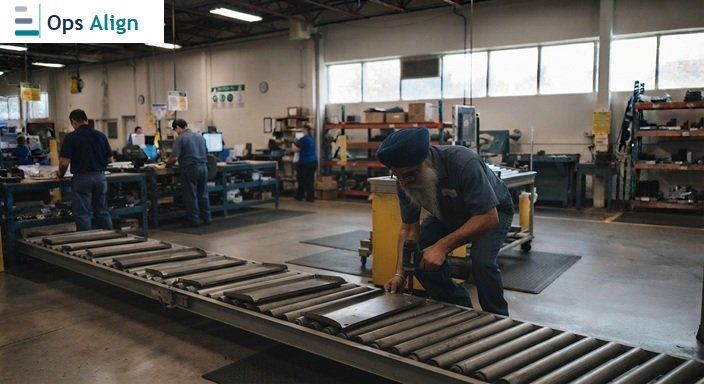
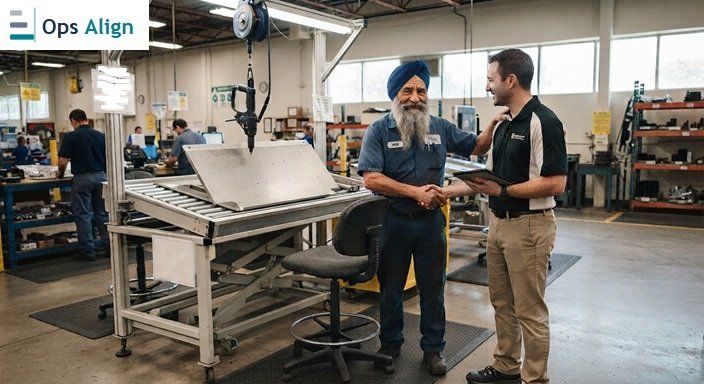
Images illustrate the workstation changes described by our founder; they are not photographs of the original installation.
Changing the workstation
I commissioned a Workplace Ergonomic Risk Assessment, and we modified the work.
We installed a tool balancer to support the rivet gun. We automated and raised the conveyor to his working height, so he no longer had to pull the heavy panels towards himself or bend down to work.
We added an anti-fatigue mat and a high chair so he could sit between units.
We also scheduled job rotation every two hours. That gave him a break from repeating the same task, helped him learn other skills and built cross-training into his development and year-end appraisal.
A result that held
After the workstation improvements, daily output increased from approximately 202 to 247 units and remained at that level. That was 45 additional units a day, approximately a 22.3% increase.
Several changes were made together. This is the sustained result I observed at the workstation; it does not isolate the contribution of each individual change.
The operator's words mattered just as much to me. A man who had felt written off could contribute with pride again.
What factory owners can take from this
When we talk about improving a factory, we usually talk about cycle times, scrap, changeovers and delivery. Sometimes, the improvement starts by looking closely at what we are asking a person to do eight hours a day.
Look at the working height, the weight being supported, the reaches, the repetition and the way material arrives. Listen to the person doing the job before deciding that the person is the problem.
Experienced people carry judgment that takes years to develop. Keeping that capability in the business takes deliberate work: adapting jobs, making time for cross-training, and turning what people know into standard work others can learn and improve.
For an owner, that means a stronger team. For someone acquiring the business, it is a practical example of maintaining experience while building capability across more people.
Common questions
Can ergonomic changes really improve factory output?
Yes. In this case raising the conveyor, adding a tool balancer, seating and job rotation lifted output at one workstation from about 202 to 247 units a day, and the result held.
What should a manufacturer check before calling an operator slow?
Look at the work first: working height, the weight being held, reaches, repetition and how material arrives. A workstation that forces bending and heavy lifting will slow anyone down.
Where can Ontario manufacturers find ergonomics guidance?
The Canadian Centre for Occupational Health and Safety (CCOHS) publishes practical guidance on hand tools, standing work and job rotation. A workplace ergonomic risk assessment is a good first step.
Want a second set of eyes on your floor?
See how OpsAlign works with owner-led factories on the floor, from a first audit to a team that runs it.
Explore servicesSources and author note
Case details and output figures are Nash Krishnan's firsthand account. Images are illustrative reconstructions.
General ergonomics guidance from the Canadian Centre for Occupational Health and Safety (CCOHS). These references support the general practices described here; they do not verify the case figures above.
- CCOHS, Hand Tool Ergonomics: Workspace Design (tool balancers, tool weight, avoiding bending over the work)
- CCOHS, Working in a Standing Position: Basic Information (work height, mats, seating, changing positions)
- CCOHS, Job Design (job rotation, repetition and rest breaks)

About the author: Nash Krishnan is the founder of OpsAlign and a manufacturing turnaround specialist. He helps owner-led manufacturers strengthen daily execution, leadership routines and problem-solving capability so the operation depends less on the owner.