
7-Month Results
Results are from this specific manufacturing turnaround and are based on internal operating data from the engagement. Identifying details have been changed or withheld to protect confidentiality.
A Factory Story
Here is a simple story from a factory I was brought into to help turn around.
The company had two locations. One was the main plant. The second was a much smaller facility where they painted and laminated structural glass and glass walls used in condominium projects.
The work had to be precise.
Same colour. Same shade. Same thickness. Correct quantity. On time.
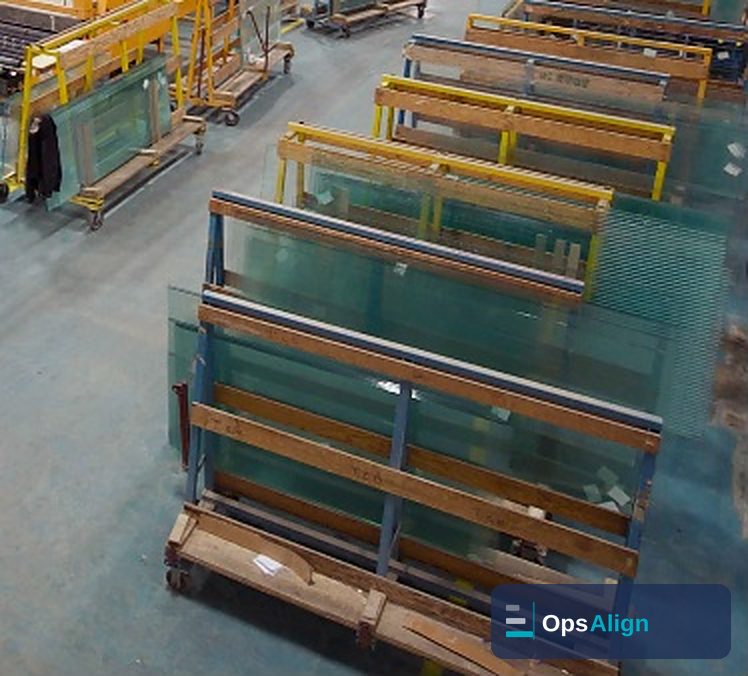
The second facility had only four operators. One was new. One was John, a senior operator who had been there for decades.
He had no formal title, no clear career path, and was still earning close to minimum wage.
The place was poorly kept and not organised. The energy was very negative. People screamed at each other.
One of the biggest problems was communication between the two plants.
Plant 1 would need a certain batch of glass from Plant 2, but the information was often passed by phone. Sometimes even the drivers moving between the two locations became part of the communication chain.
Someone would say something to someone else, who would then repeat it to the scheduler.
By the time the information reached the person making the production plan, it could already be incomplete, misunderstood or wrong.
That caused daily problems.
Wrong quantities.
Wrong colour priorities.
Missing pieces.
Late batches.
Paint stock being used for another job.
Plant 2 sometimes having to work late or on weekends to recover.
And Plant 1 sometimes waiting for material that everyone thought was coming.
The Friday Everything Came to a Head
I remember one Friday especially.
Plant 1 had planned Saturday overtime based on the expected supply from Plant 2.
Only on Friday did we realise Plant 2 had started the required batch too late.
They tried to recover late Friday, but they could not produce enough glass in time for the next day's run.
Workers came in for Saturday overtime at Plant 1 and had to be sent home because there was not enough material to run.
They were upset and angry. Some shouted.
They also needed those hours, and they felt it was unfair that they were paying for a mistake somewhere else in the system.
At Plant 2, John was taking the pressure personally.
He was angry at himself. He felt helpless. He felt nobody appreciated him or had ever helped him become better at what he was doing.
He walked off.
I had only been at the company about one week.
I went after him and spoke with him.
I told him I would work on his wage, formalise his role, and restructure how the two plants worked together.
He came back.
That Friday night I bought some food and drinks and stayed with them while they worked to recover the situation.
That incident stayed with me because the problem looked like a scheduling failure.
It wasn't.
It was scheduling, communication, maintenance, quality, inventory, leadership, morale and role clarity all mixed together.
One Very Simple Technology Fix
One of the first solutions was very simple.
I set up a shared Google Sheet between the scheduler in Plant 1 and John in Plant 2.
It included:
- PO numbers
- quantities
- colour codes
- paint-stock status
- scheduled start and end dates
- delivery day and time
- comments from the scheduler
- comments from John
- quality data
- pictures
I also added colour coding so both people could quickly see what required attention.
It was not sophisticated technology.
But it removed a lot of the hearsay.
Now both people could look at the same information.
The scheduler did not need to rely on a phone call or a story coming back with a driver.
John could see what was coming, what was urgent, whether the correct colour stock was available, and when Plant 1 actually needed the material.
I trained both of them personally for a few days.
As this started working, their stress level came down. Their demeanour changed.
The scheduler in Plant 1 actually became proud of the system and started showing the owners how she was using the technology to manage the work.
The Spreadsheet Wasn't Enough
But the spreadsheet alone would never have fixed the problem.
John had been there for decades, yet he had no formal position.
I worked with finance and ownership to correct his wage, formalise his responsibilities and promote him to Team Lead.
I brought the Plant 2 team together and announced his promotion.
John looked surprised.
Then he smiled.
I had not seen him smile before.
Most of the operators clapped.
A few were not happy, which is normal, but the majority felt it was timely and the right thing to do.
I also explained to John that this was not the end of his progress. There could be more opportunity for him.
We introduced an annual performance-review process tied to bonus and wage progression, something the plant had never had before.
Then I worked with John for months.
I showed him how to run the morning meeting, organise samples and materials, use FIFO, improve basic 5S, manage information coming from Plant 1, and lead his team with more confidence.
Making Quality Visible
Quality was another major problem.
When I arrived, rework was around 40%.
Operators were doing some quality checks, but quietly. There was no meaningful charting, no visibility for management, and nobody really knew the overall numbers.
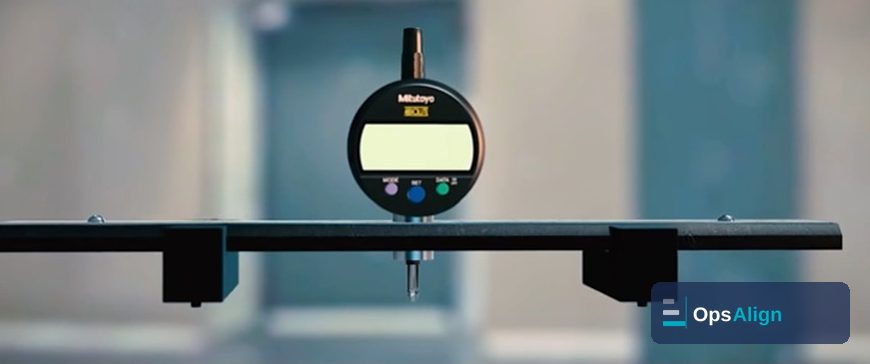
We started charting:
- paint depth
- roller-wave limits
- localized warp
These checks were done during the shift, including after breaks.
If material was outside the required condition, it was separated for rework. Only good material was released onward.
Quality was no longer something discovered downstream. It became part of the production process.
When a Quality Problem Is Really a Maintenance Problem
We also introduced shift-start checks and, for the first time, preventive maintenance on the paint and laminating machines.
One issue I remember clearly involved the nip roller on the double-roller laminating machine.
There was asymmetric pressure from left to right.
Even a small difference in the roller gap could create uneven compression through the glass sandwich and contribute to thickness variation.
The machine had a history of patch-up maintenance.
People had become used to keeping equipment going with whatever repair was available instead of always correcting the underlying mechanical condition properly.
We measured the left and right side, confirmed the imbalance, recalibrated the system and corrected worn components.
There was a marked improvement.
But it was not one magic fix. There were other issues like this that had to be addressed one by one.
That is one thing I learned very clearly from factory turnarounds:
You rarely find one big problem. You find many small problems that everybody has slowly accepted as normal.
Maintenance Became Visible Too
We formalised maintenance requisitions.
Requests were copied to me.
Mission-critical issues were escalated when the maintenance team could not resolve them.
Quality data was made visible to top management and brought into the weekly management meeting.
That changed behaviour too.
Maintenance could no longer disappear into the background until something broke badly enough to stop production.
Changing the Leadership System
At the same time, I was coaching the ownership group and department heads.
We held weekly leadership sessions. They were interactive.
The principle I kept coming back to was simple:
Deal with the issue, not the person.
The culture had been very top-down.
People were used to shouting, blaming and protecting themselves.
I was trying to move the organisation toward surfacing problems, owning them, solving them and learning from them.
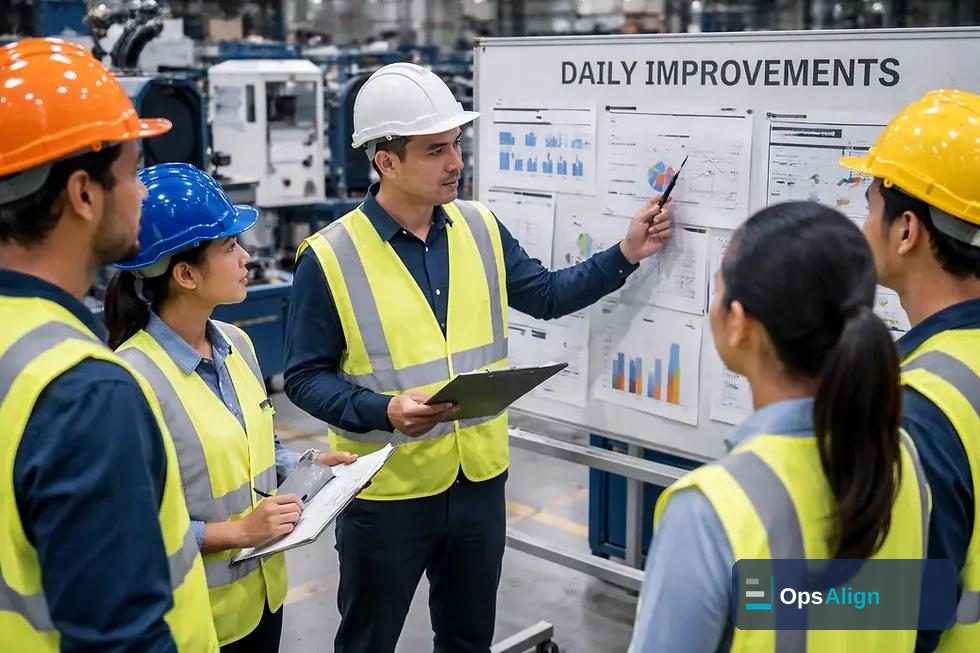
We also ran team-building sessions with leadership and with the wider plant.
The Results
Within about seven months:
- Rework fell from approximately 40% to 4%
- On-time delivery for painted and laminated glass improved from approximately 69% to 98%
- Customer complaints related to colour and lamination dropped from about 3 per month to 0.35 per month
Those results did not come from one tool.
They came from a combination of:
- quality gates
- preventive maintenance
- maintenance escalation
- FIFO and stock control
- clearer production scheduling
- role clarification
- wage balancing
- promotion and frontline leadership
- a shared digital scheduling system
- employee training
- morning meetings
- leadership coaching
- ownership alignment
A Factory Is More Like a Body Than a Collection of Departments
What this reinforced for me is that a factory is like our body.
Everything is interconnected.
You cannot resolve one part in isolation and expect the whole factory to become healthy.
Scheduling affects production.
Production affects quality.
Quality affects rework.
Rework affects maintenance.
Maintenance affects delivery.
Leadership affects whether problems are hidden or discussed.
Pay, recognition and development affect whether experienced people care enough to stay and grow.
Communication connects all of it.
That is why I don't think factory transformation is mainly about installing Lean tools, software or dashboards.
Those things matter.
But the factory only really changes when the technical system and the human system start working together.
That is when it begins to become a living, breathing organisation rather than a collection of machines and departments.
Common questions
What causes high rework in a manufacturing plant?
Rework often looks like a quality problem but starts elsewhere: poorly maintained equipment, unclear standards, schedules that rush jobs and departments that do not share information.
How long does it take to reduce rework significantly?
In this plant rework fell from 40% to 4% over about seven months. Results depend on the plant, but visible daily measures and fixing root causes usually show progress within weeks.
Why fix maintenance and leadership together with quality?
Because they are connected. When maintenance became visible and supervisors led daily problem solving, quality gains stopped slipping back. Fixing one department in isolation rarely holds.
